
Spoken Location
Product: Prepared ACT
Audience: Call Takers, Dispatchers, Supervisors, and Administrators
Last Updated: 02/24/2026
Outcome Statement
After reading this section, you will be able to understand and use the Spoken Location feature to automatically extract and display a caller’s spoken location from the call transcript.
Overview
The Spoken Location feature allows Prepared to extract spoken locations from call transcripts, such as addresses, landmarks, cross streets, or mile markers. This feature then queries Google Maps to validate the location and plots it on a map. It automatically simplifies the process for PSAP call takers by removing the need for manual transcription and cross-referencing, improving speed and accuracy in emergency response.
How the Spoken Location Feature Works
The Spoken Location feature operates as follows:
Spoken Location Identification: The feature automatically extracts the caller's stated location, such as an address, landmark, or mile marker, from the call transcript.
Location Validation: Prepared queries Google Maps to validate the extracted location and match it to a precise street address, using EED/ELS/ALI location data to bias the results for better accuracy.
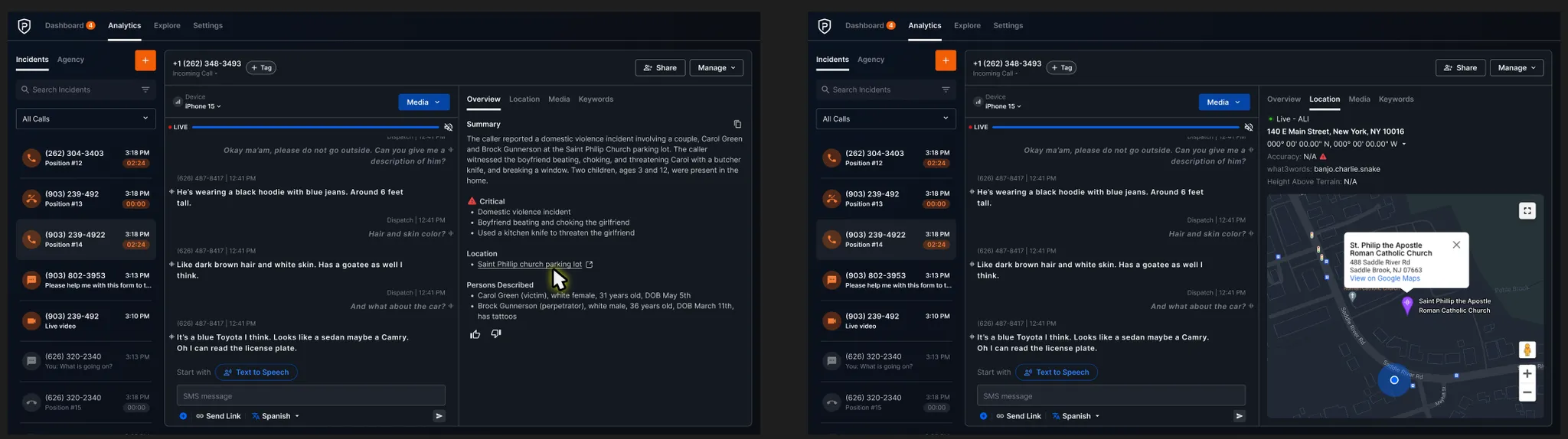
Display the Location on the Map: Once the location is validated, it is displayed on the Prepared platform’s map. Users can click on the location from the Insights section to automatically view it on the map.
Interactive Insights: Users can click a hyperlink to open the location directly in Google Maps for additional details or directions.
Multiple Locations: If multiple locations are mentioned during the call, Prepared will display up to four validated options. These options are ordered by recency, with the most recent at the top.
Why is This Feature Important?
Faster and More Accurate Dispatching: Call takers often rely on a caller’s self-reported location, which can be prone to error. This feature simplifies the process and helps validate locations faster, allowing for more accurate dispatching.
Improves Call Taker Efficiency: By automatically extracting spoken locations and validating them with Google Maps, the feature eliminates the need for manual transcription, reducing call taker workload and errors.
Better for Callers Who Don’t Know Their Exact Location: Many callers may only know landmarks or nearby locations. The spoken location feature helps find those locations quickly, even when the caller isn't sure of the exact address.
How Accurate Is the Spoken Location Feature?
Accuracy Rate: As of 1/17/24, 95% of calls with a spoken location prediction are correct!
Spoken Location Predictions: As of 1/17/24, 71% of emergency calls have spoken location predictions.
Continuous Improvement: The accuracy of the spoken location feature continues to improve as more data is collected, and the system learns from ongoing usage.
Examples Where Spoken Location is Better Than ALI/Device Location
The spoken location feature often provides better accuracy than ALI or device location, especially when callers describe nearby landmarks or areas.
Example 1: A caller mentions a landmark, which the spoken location feature successfully identifies, while ALI gives an inaccurate address.
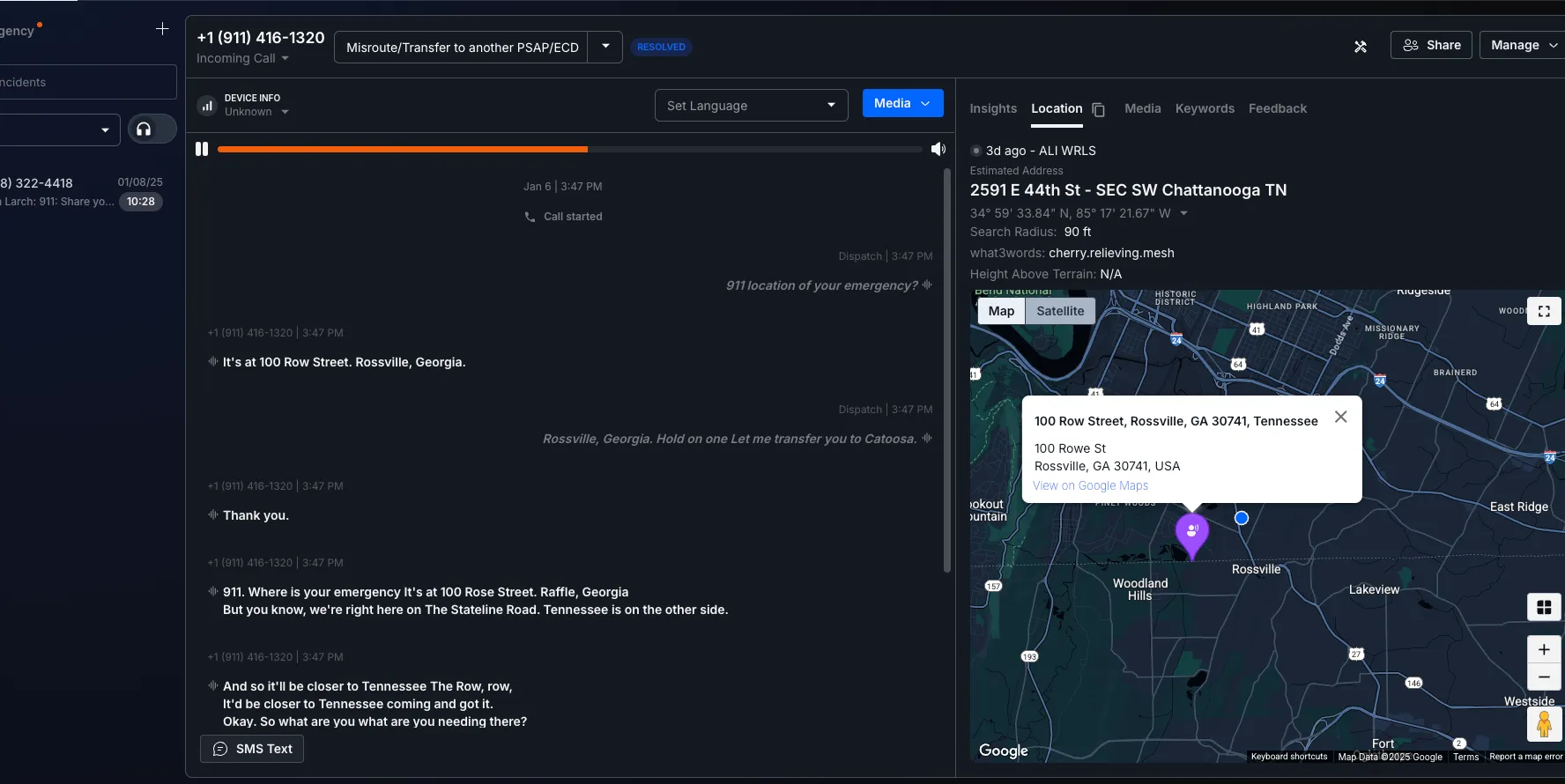
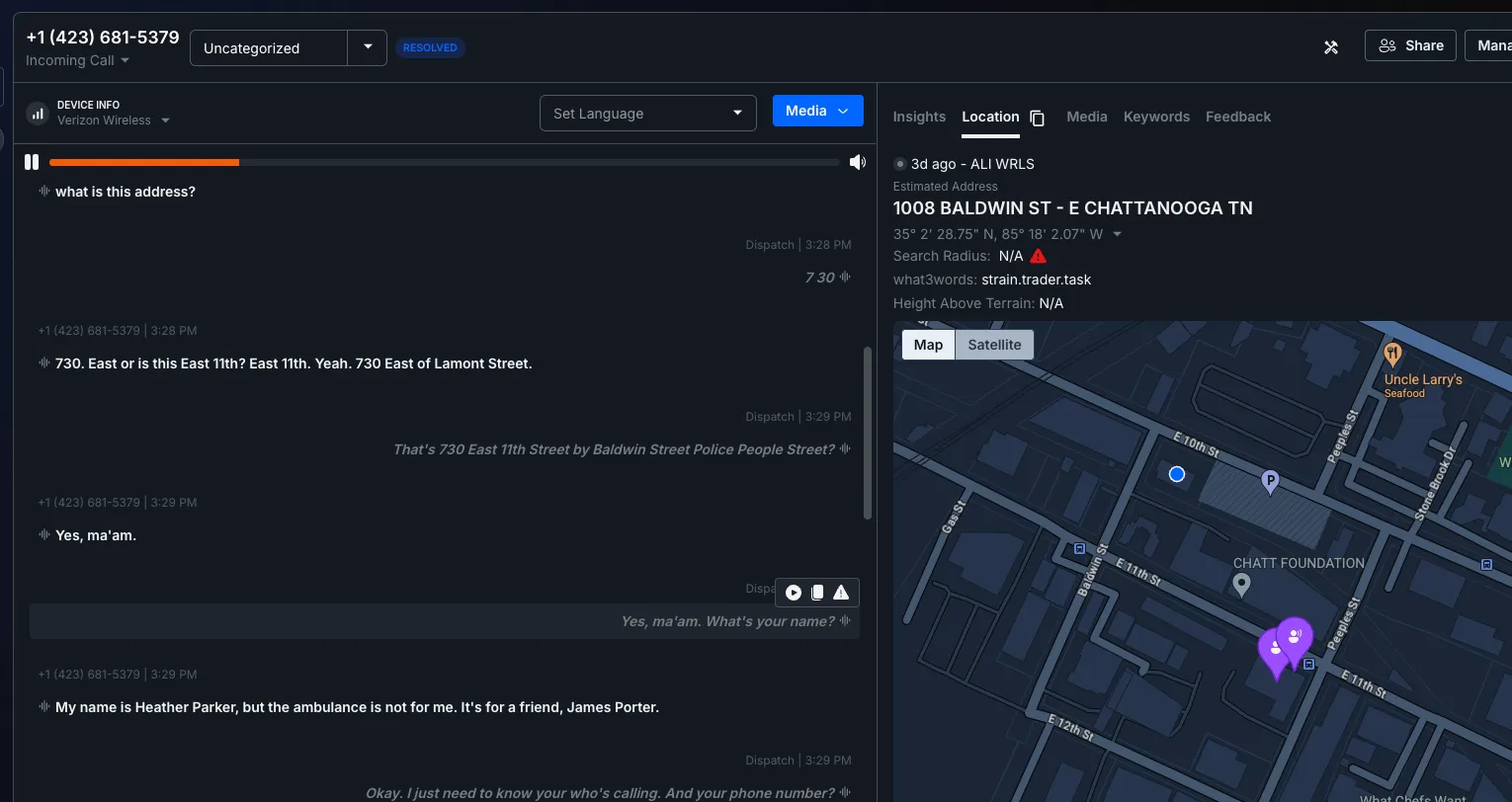
Example 2: A gas station is identified more accurately through the spoken location than ALI data.
Understand the Limitations of the Spoken Location Feature
The Spoken Location feature is a powerful assistive tool. However, it has important limitations you must understand before relying on it operationally.
It Requires a Recognizable Location Phrase
The feature only works when the transcript contains a clear and recognizable location, such as:
A street address
A landmark
Cross streets
A mile marker
If the caller is vague (for example, “I’m near a building”) or audio/transcription quality is poor, the system may not generate a spoken location.
It depends on Google Maps validation.
After extracting a location, Prepared queries to Google Maps to validate it.
If Google Maps cannot confidently match what was spoken to a usable address or place, the location may not plot on the map.
It Uses Other Location Sources as Anchors
The system uses ANI/ALI, device location, EED, or ELS data to bias and refine results.
This improves overall accuracy. However:
If those anchor sources are missing
If they are inaccurate
Or if they conflict with what was spoken
The results may be limited or influenced by those inputs.
Spoken Location search results are also limited to locations within approximately 1 kilometer of the caller’s ALI location.
This geographic bias helps prevent distant or unrelated locations from being returned and keeps the results focused on the caller’s likely area.
It Displays a Limited Number of Results
The system displays only a small number of validated spoken locations per call to reduce distraction.
If multiple locations are mentioned, only the most recent and most confident matches will appear.
It Does Not Replace Verbal Verification
You must still:
Confirm the location verbally with the caller
Compare it against ANI/ALI or device-based location
Follow your agency’s dispatch verification protocols
Spoken Location is designed to assist your workflow — not replace confirmation procedures.
It May Not Appear Immediately
Spoken Location is generated after enough transcript data is available.
Because of this, there may be a brief delay before a prediction appears during the call.
Support & Additional Resources
Contact Prepared Support: Support@prepared911.com